

About the university
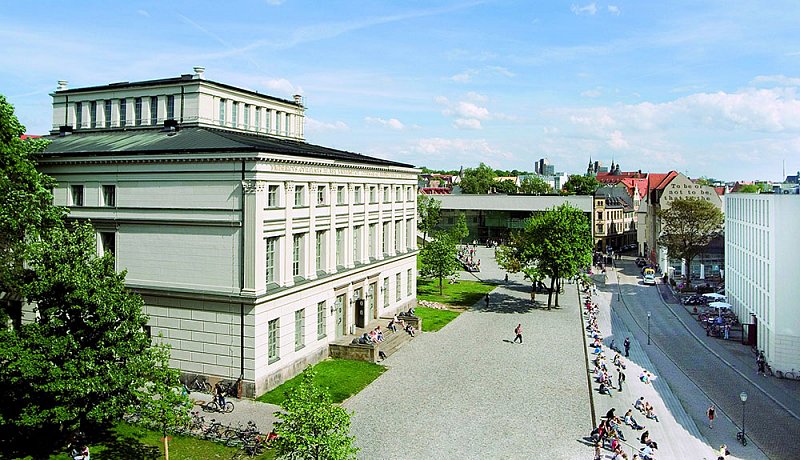
Universitätsplatz (Photo: Norbert Kaltwaßer)
Excellent in Research, Strong for the Region
Martin Luther University Halle-Wittenberg (MLU) has been synonymous with research and teaching of the highest standard for more than 500 years. Today, it offers a wide range of degree programmes in the humanities, social sciences, natural sciences and medicine. It is a place where knowledge is created, critical thinking is fostered, and academic freedom is firmly practised.
Saxony-Anhalt’s largest and most historic university was established in 1817 when the University of Wittenberg (est. 1502) merged with Friedrich University Halle (est. 1694). MLU is an international university with deep roots in the Central German region. It has around 19,000 students, 350 professors and more than 4,000 staff members.
In addition to the Weinberg Campus, MLU has three other main locations. The university’s main buildings are on the centrally located University Square, considered to be one of the most beautiful in Europe. Steintor Campus is the site of many of the institutes dedicated to the humanities and social sciences. The Francke Foundations house the faculties of Educational Science and Theology.
Research Profile
MLU’s scientific profile is shaped by the three profile lines “transformation”, “sustainability” and “knowledge cultures and education”. Building on this, the university focuses its scientific strengths in four core research areas:
- plurality, participation, enlightenment
- health and society in transformation
- building blocks of the future:
- from plants to macromolecules
- from mineral resources to nanoelectronics
With these interdisciplinary areas, the university combines basic research with innovation, while allowing it to address key scientific and societal challenges of both the present and the future.
The Cluster of Excellence “Center for Chiral Electronics” is a prime example of the university’s academic success. It is run by MLU in collaboration with partners from Halle, Regensburg and Berlin as part of the Excellence Strategy of the German federal and state governments. Researchers in the cluster are working at the intersection of physics and chemistry, developing concepts for high-performance, energy-efficient electronics.
Science and Structural Change
Not only is the university’s profile shaped by transformation, sustainability, knowledge cultures and education, the topics are also of great importance to the region. The phase-out of coal, and challenges such as demographic change, climate change and species extinction, represent fundamental upheavals in Saxony-Anhalt’s economy and people’s everyday lives. At the same time, new opportunities for innovation, value creation, training and sustainable development are emerging. As the centre of transformation research in the state of Saxony-Anhalt, MLU supports these developments with scientifically robust and practice-oriented proposals for the future. This commitment is reflected in the major structural change projects “Just Transition Center” (JTC), “DiP Saxony-Anhalt – Model Region for the Bioeconomy” and “TPG – The Digital Future of Nursing and Healthcare”, which are coordinated by MLU.
Studying at MLU
MLU is also setting new standards in teaching. Students can choose from more than 150 undergraduate and almost 80 postgraduate degree programmes, many of which can be freely combined. This includes many subjects rarely found in Germany, such as speech science and medical physics. In line with its profile lines, the university continues to develop its degree programmes to a high academic standard and engages intensively with current issues such as digitisation and artificial intelligence. MLU plays a central role in training teachers for general-education schools in Saxony-Anhalt, offering 1,000 places per academic year. A total of more than 4,000 trainee teachers are studying at MLU. The university is likewise responsible for educating future legal professionals in Saxony-Anhalt.
University Medicine
University Medicine Halle, which includes a large, modern hospital complex, combines research, teaching and patient care. Doctors from all specialist areas, nursing staff and midwives are trained here, for example in the Dorothea Erxleben Learning Centre, one of the largest teaching hospitals in Germany. Medical research focuses on “Molecular Medicine of Signal Transduction” and “Epidemiology & Nursing Research”.
Collections and Museums
MLU is home to more than 40 academic collections and museums, six of which are listed in the “Database of cultural property of national significance”. These include the Geiseltal Collection, which contains a unique collection of Eocene fossils, and the Meckel Collections, one of the most extensive anatomical teaching and research collections in Europe.
Strong Partners in the Region and the World
MLU is an active member of the “Central German University Alliance Halle-Jena-Leipzig” and collaborates with numerous other university and non-university research institutions. The Weinberg Campus Technology Park is a demonstration of the close partnerships in Halle. Here, the university has its natural science institutes where it collaborates with companies and institutes belonging to major research organisations: the Max Planck Society, the Fraunhofer-Gesellschaft, and the Leibniz and Helmholtz Associations. The university also has international ties to more than 100 partner universities.
Facts and figures (As per 31 Ocotober 2025)
University
Professorships: 348
Junior professorships: 22
Students: 18,789
Foreign students: 1,754
Employees (excl. Faculty of Medicine): 2,230*
Trainees (excl. Faculty of Medicine): 33*
Externally-funded employees (excl. Faculty of Medicine): 690*
*(as per 1 december 2025)
University Medicine Halle
Facilities (clinics, institutes, etc.): 100*
Faculty of Medicine employees: 880*
Externally-funded employees: 348*
University hospital employees: 4,935 and 759 trainees*
*(as per 1 december 2025)
State grants for research and teaching
University excl. Faculty of Medicine: 193,910,000 euros*
Faculty of Medicine: 77,810,000 euros*
*(as per 31 december 2025)
Further current figures can be found in the e-paper version of the ‘scientia halensis’ yearbook on pages 92 to 97.